

Sets of wood blocks
Sets of wood blocks
Regular price
214.95$
Regular price
0.00$
Sale price
214.95$
Unit price
per
Shipping calculated at checkout.
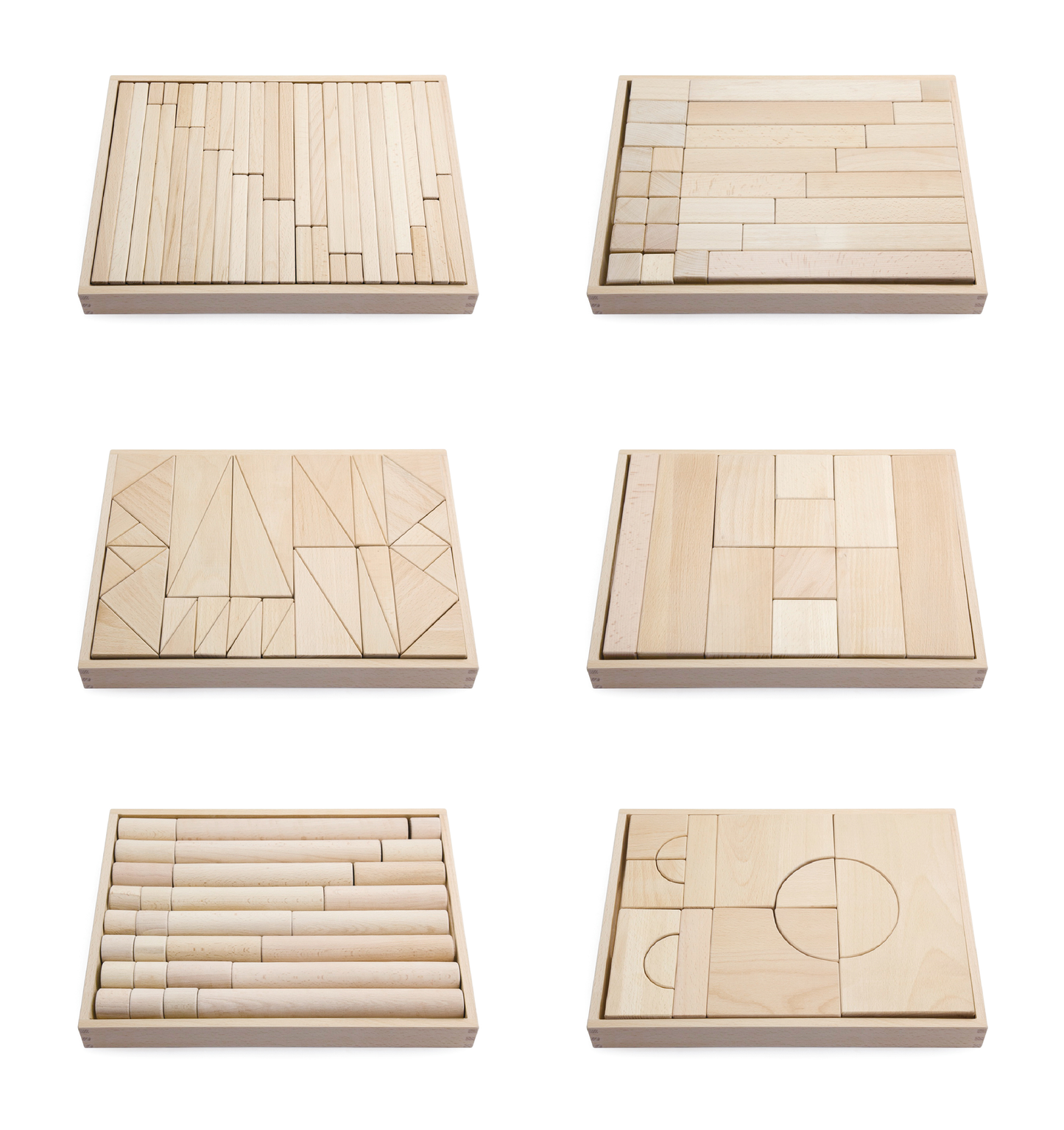
Two sets of 6 beechwood trays holding building blocks of various shapes and sizes that fit together perfectly. The trays are stackable and compatible with the rolling transport board. Dimensions: 39 x 29 x 4 cm
* As a verified institutional member, you benefit from special prices.
Log in to see the prices reserved for institutional members.
Couldn't load pickup availability

Select your choices and quantities for a quick add to your order.
0
Total items
0.00$
Taxes and delivery charges extra.
Subtotal

Fine Motor Skills
By manipulating pieces and fitting them together, children improve their dexterity, which prepares them to perform actions requiring more precise movements. A variety of activities help develop dexterity. Threading, drawing, cutting and manipulating various modelling clays gradually helps acquire the skills needed to master everyday gestures such as buttoning, lacing and zipping up and prepares children for writing. Preschoolers who do these types of activities will find it easier to trace letters.

Creativity
Creativity is the ability to imagine, build and implement something new or to discover an original solution to a problem. It is, therefore, not limited to the arts alone and develops gradually from the age of 18 months. Given its importance in a child’s development, we should seize every opportunity to stimulate it daily. Indeed, a child who has learned to be creative will have good problem-solving and conflict-solving skills, expressing themselves, exploring and finding new ideas. All types of games and activities contribute to nurturing creativity. It is important to provide the child with a variety of materials that the child can explore and use as he or she pleases. In children’s games, an ordinary piece of fabric suddenly becomes a cape, a picnic mat, a blanket for dolls, and so much more! Books, nursery rhymes, dressing-up and improvisation games, for example, fuel the imagination in wonderful ways and inspire fun in the young and old alike.

Observation
We ask children to exercise this skill every day in a multitude of activities. It is important to know that observation is never practiced alone: observing always requires concentration. This allows us to maintain attention while we gather information and commit it to our memory. How can we encourage the development of observation skills in children? First, it is important that the type of game and the difficulty level chosen are adapted to the child. The environment must be conducive to focus; it is essential to limit sources of distraction and to make the child comfortable. Guiding the child by asking questions can also help. To stimulate observation skills, we usually gravitate towards memory games, sorting games, sequence games or puzzles of all kinds, and that is great! But observation can also be practiced with all our senses. There are a variety of materials and activities that allow children to listen, touch, taste, look, smell, etc.

Gross Motor Skills
Gross motor skills include balance, coordination, lateralization, strength, endurance, etc. Motor skills involve performing body movements and maintaining positions. Like all other skills, motor skills are acquired through practice, and repetition allows them to be refined and developed further. Motor activities and games promote spatial orientation and encourage children and adults alike to expend their energy in a positive way. The same activity often adapts well to children at different stages of development.
Two sets of 6 beechwood trays holding building blocks of various shapes and sizes that fit together perfectly. The trays are stackable and compatible with the rolling transport board. Dimensions: 39 x 29 x 4 cm


