

Match & Mix Kids
Match & Mix Kids
SKU: SKU : 2097004 Vendor : Brault & Bouthillier
3 ans +
Regular price
24.95$
Regular price
0.00$
Sale price
24.95$
Unit price
per
Shipping calculated at checkout.
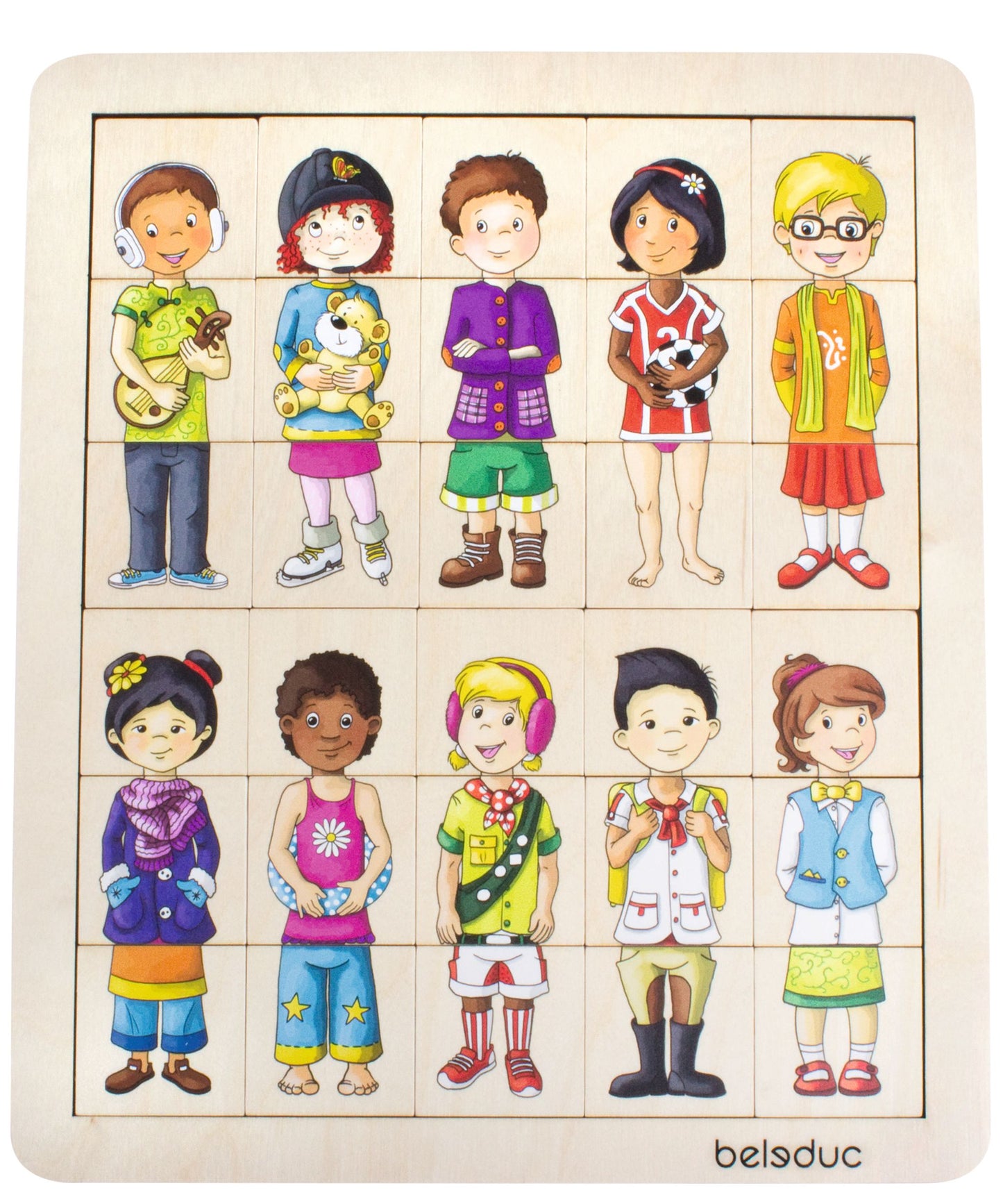
Assemble 10 children representing a variety of ethnic groups, each made of 3 pieces (head, torso, legs) or mix and match the pieces to create whimsical kids. Can you give each one a name? Also play a memory game, turning the tiles 3 at a time to ...
Show more
* As a verified institutional member, you benefit from special prices.
Log in to see the prices reserved for institutional members.
In stock
Couldn't load pickup availability

Fine Motor Skills
By manipulating pieces and fitting them together, children improve their dexterity, which prepares them to perform actions requiring more precise movements. A variety of activities help develop dexterity. Threading, drawing, cutting and manipulating various modelling clays gradually helps acquire the skills needed to master everyday gestures such as buttoning, lacing and zipping up and prepares children for writing. Preschoolers who do these types of activities will find it easier to trace letters.

Memory
Sensory, short-term, long-term: there are different types of memory, which all work together. Sensory memory very briefly retains the information gathered by the senses, just long enough to store it in short-term memory. Short-term memory then only lasts a few seconds, but it allows you to process and retain information to store it in long-term memory for days, months, or even your entire life to retain significant events, the meaning of words, manual skills, etc. If you want play and memory development in children to go hand-in-hand, remember this: observation is important for memory development. You must limit the amount of information that a child must retain at once and make connections between the game he or she is playing with you and his or her past experiences (a visit to the farm, a party, or a book, for example, exercises his or her long-term memory and can enrich the activity you are doing).

Space-Time
Space and time are at the heart of children's daily activities: drawing, writing, moving a piece on a game board, putting together a puzzle or building a building, as well as identifying landmarks to get from one point to another. All of these call for spatial organization and orientation. Furthermore, telling a story, correctly ordering a sequence of events, learning the time, and carrying out an activity in a set amount of time all call for temporal organization and orientation. All of these concepts are gradually developed through various motor and cognitive skills. This is easily observed in the development of children's language when they use the words inside, outside, next to, behind, before, after, yesterday and tomorrow. In short, skills related to spatial and temporal organization impact several areas of children's development.

Creativity
Creativity is the ability to imagine, build and implement something new or to discover an original solution to a problem. It is, therefore, not limited to the arts alone and develops gradually from the age of 18 months. Given its importance in a child’s development, we should seize every opportunity to stimulate it daily. Indeed, a child who has learned to be creative will have good problem-solving and conflict-solving skills, expressing themselves, exploring and finding new ideas. All types of games and activities contribute to nurturing creativity. It is important to provide the child with a variety of materials that the child can explore and use as he or she pleases. In children’s games, an ordinary piece of fabric suddenly becomes a cape, a picnic mat, a blanket for dolls, and so much more! Books, nursery rhymes, dressing-up and improvisation games, for example, fuel the imagination in wonderful ways and inspire fun in the young and old alike.


