

Life Cycles – Monarch Butterfly
Life Cycles – Monarch Butterfly
SKU: SKU : 2339695 Vendor : SAFARI
Regular price
17.95$
Regular price
0.00$
Sale price
17.95$
Unit price
per
Shipping calculated at checkout.
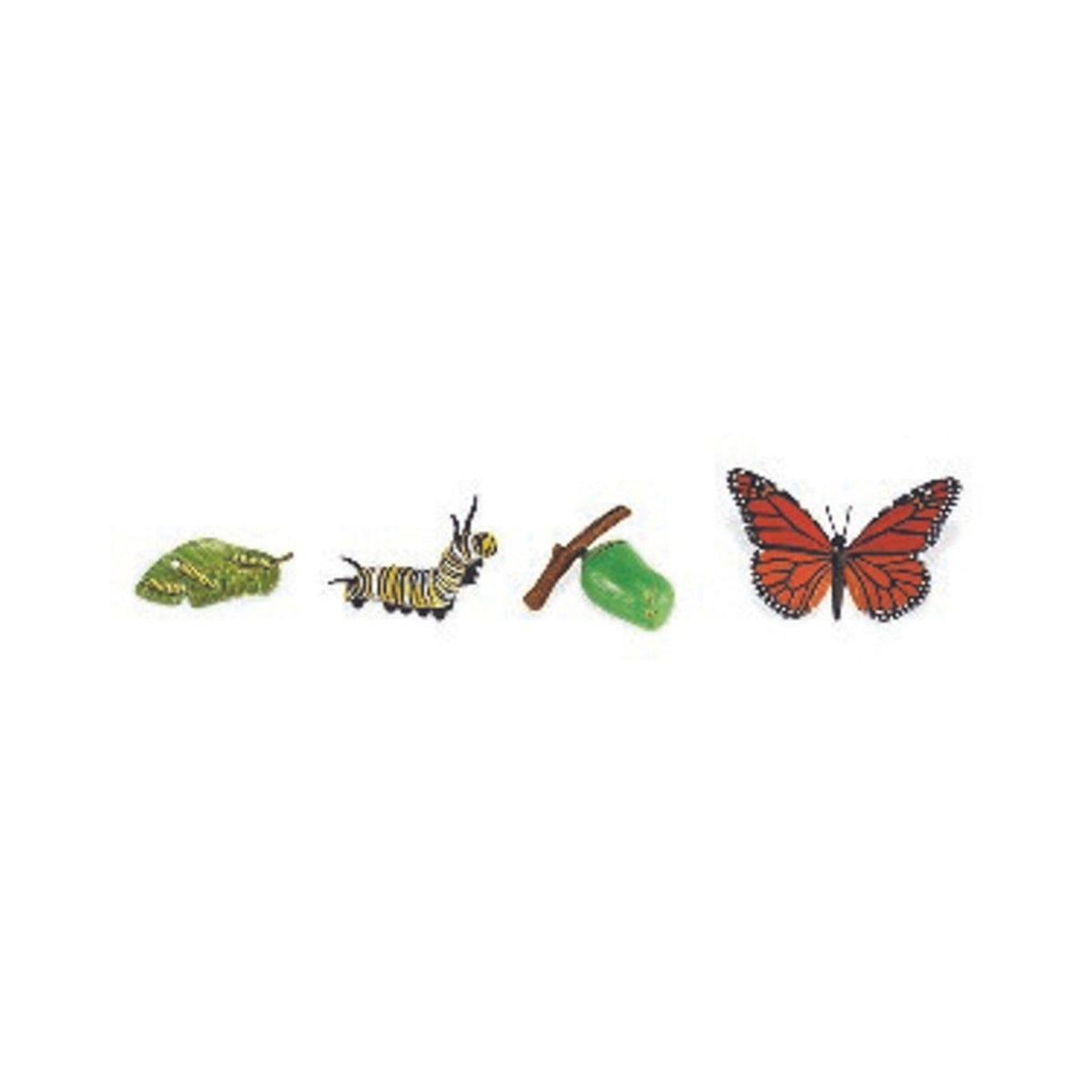
Great hands-on 3-D set features the life cycle in 4 stages. Includes 4 pieces, in sturdy hard or flexible plastic painted in realistic colours and details, with information on the back of the blister card. Stages: Eggs, caterpillar, chrysalis, mo ...
Show more
* As a verified institutional member, you benefit from special prices.
Log in to see the prices reserved for institutional members.
In stock
Couldn't load pickup availability

Fine Motor Skills
By manipulating pieces and fitting them together, children improve their dexterity, which prepares them to perform actions requiring more precise movements. A variety of activities help develop dexterity. Threading, drawing, cutting and manipulating various modelling clays gradually helps acquire the skills needed to master everyday gestures such as buttoning, lacing and zipping up and prepares children for writing. Preschoolers who do these types of activities will find it easier to trace letters.

General Knowledge
Children are naturally curious and eager to learn. Anyone who has tried to answer a child's many questions can attest to this. Play is, therefore, a great tool for developing general knowledge. All you need to do is vary the material and create opportunities for learning by using books, question-and-answer games, picture books or thematic activities with the appropriate support material. All these activities allow children to take control of the world around them, broaden their horizons, awaken their interests, develop their curiosity and activate several cognitive processes. This also promotes their social and emotional development. By observing the activities and games that children engage in, you can find ideas for activities and themes related to their interests and whose content and difficulty level will be adapted to them.

Observation
We ask children to exercise this skill every day in a multitude of activities. It is important to know that observation is never practiced alone: observing always requires concentration. This allows us to maintain attention while we gather information and commit it to our memory. How can we encourage the development of observation skills in children? First, it is important that the type of game and the difficulty level chosen are adapted to the child. The environment must be conducive to focus; it is essential to limit sources of distraction and to make the child comfortable. Guiding the child by asking questions can also help. To stimulate observation skills, we usually gravitate towards memory games, sorting games, sequence games or puzzles of all kinds, and that is great! But observation can also be practiced with all our senses. There are a variety of materials and activities that allow children to listen, touch, taste, look, smell, etc.

Space-Time
Space and time are at the heart of children's daily activities: drawing, writing, moving a piece on a game board, putting together a puzzle or building a building, as well as identifying landmarks to get from one point to another. All of these call for spatial organization and orientation. Furthermore, telling a story, correctly ordering a sequence of events, learning the time, and carrying out an activity in a set amount of time all call for temporal organization and orientation. All of these concepts are gradually developed through various motor and cognitive skills. This is easily observed in the development of children's language when they use the words inside, outside, next to, behind, before, after, yesterday and tomorrow. In short, skills related to spatial and temporal organization impact several areas of children's development.


