

SKU: SKU: 2356558
Regular price
32.95$
Regular price
Sale price
32.95$
Unit price
per
Shipping calculated at checkout.
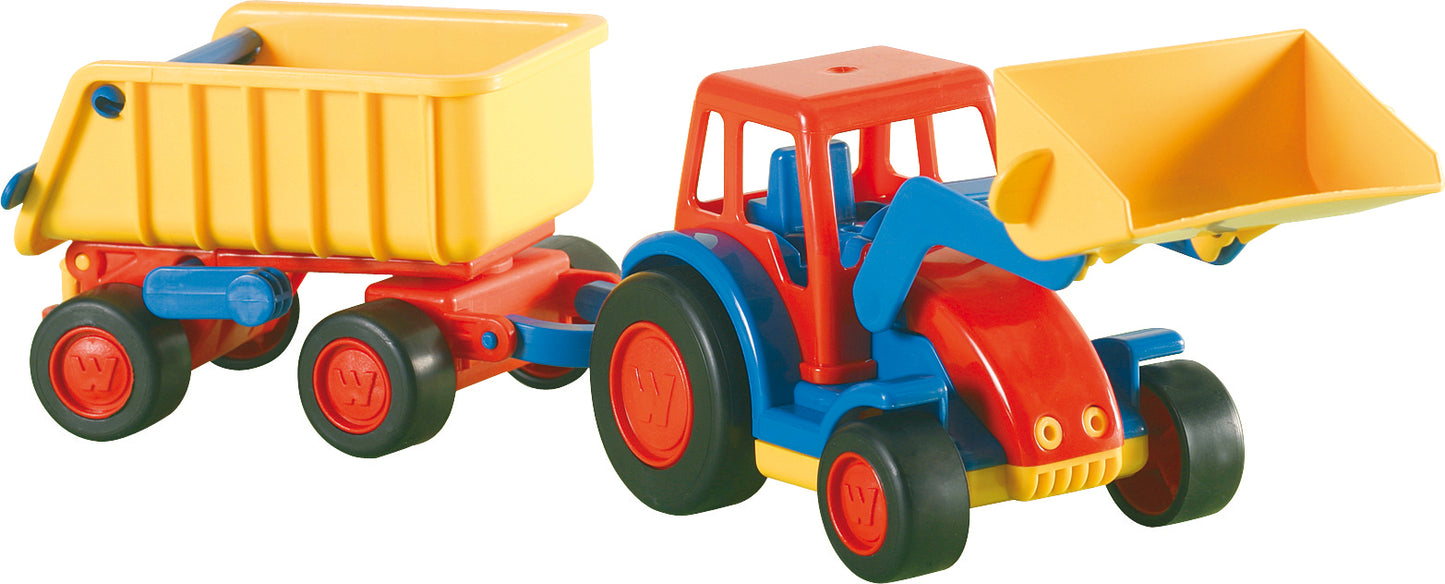
Petits camions articulés, avec pièces mobiles, pneus en caoutchouc, boutons et manivelles texturés facilitant la préhension. Parfaits dans le bac à sable. Plastique robuste. 21 cm de longueur environ.
* As a verified institutional member, you benefit from special prices.
Log in to see the prices reserved for institutional members.
Couldn't load pickup availability

Gross Motor Skills
Gross motor skills include balance, coordination, lateralization, strength, endurance, etc. Motor skills involve performing body movements and maintaining positions. Like all other skills, motor skills are acquired through practice, and repetition allows them to be refined and developed further. Motor activities and games promote spatial orientation and encourage children and adults alike to expend their energy in a positive way. The same activity often adapts well to children at different stages of development.

Fine Motor Skills
By manipulating pieces and fitting them together, children improve their dexterity, which prepares them to perform actions requiring more precise movements. A variety of activities help develop dexterity. Threading, drawing, cutting and manipulating various modelling clays gradually helps acquire the skills needed to master everyday gestures such as buttoning, lacing and zipping up and prepares children for writing. Preschoolers who do these types of activities will find it easier to trace letters.

General Knowledge
Children are naturally curious and eager to learn. Anyone who has tried to answer a child's many questions can attest to this. Play is, therefore, a great tool for developing general knowledge. All you need to do is vary the material and create opportunities for learning by using books, question-and-answer games, picture books or thematic activities with the appropriate support material. All these activities allow children to take control of the world around them, broaden their horizons, awaken their interests, develop their curiosity and activate several cognitive processes. This also promotes their social and emotional development. By observing the activities and games that children engage in, you can find ideas for activities and themes related to their interests and whose content and difficulty level will be adapted to them.

Memory
Sensory, short-term, long-term: there are different types of memory, which all work together. Sensory memory very briefly retains the information gathered by the senses, just long enough to store it in short-term memory. Short-term memory then only lasts a few seconds, but it allows you to process and retain information to store it in long-term memory for days, months, or even your entire life to retain significant events, the meaning of words, manual skills, etc. If you want play and memory development in children to go hand-in-hand, remember this: observation is important for memory development. You must limit the amount of information that a child must retain at once and make connections between the game he or she is playing with you and his or her past experiences (a visit to the farm, a party, or a book, for example, exercises his or her long-term memory and can enrich the activity you are doing).

Observation
We ask children to exercise this skill every day in a multitude of activities. It is important to know that observation is never practiced alone: observing always requires concentration. This allows us to maintain attention while we gather information and commit it to our memory. How can we encourage the development of observation skills in children? First, it is important that the type of game and the difficulty level chosen are adapted to the child. The environment must be conducive to focus; it is essential to limit sources of distraction and to make the child comfortable. Guiding the child by asking questions can also help. To stimulate observation skills, we usually gravitate towards memory games, sorting games, sequence games or puzzles of all kinds, and that is great! But observation can also be practiced with all our senses. There are a variety of materials and activities that allow children to listen, touch, taste, look, smell, etc.

Concentration
Concentration is the ability to focus attention on a single subject. Whether with work, reading or play, the process is always the same, and it is essential for learning. However, the ability to concentrate varies greatly depending on age and neurological development. Play is a natural ally of concentration. Anyone who has observed a child playing can attest to this. Many things can stimulate concentration. First, it is important to provide the child with a favourable learning environment: limit noise, have adequate physical and material organization, and fit the task duration as well as the challenge level to the child's abilities. Encouraging the child to follow a path with their finger, closing their eyes so that they listen to sounds, and reminding them of some of the characteristics of the task are strategies that help develop concentration. Finally, asking the child what they did to complete a task allows them to apply their strategies in other contexts.

Logical Reasoning
Logical thinking develops as children interact with their environment. Initially, they develop their reasoning through observations, comparisons and classifications of objects to then establish what distinguishes them or what unites them. Several activities require logical reasoning: solving a 3-D puzzle, doing a scientific experiment, building a model using instructions or playing chess. All of these activities require reflection and concentration and even call upon the ability to develop hypotheses and deductions in order to develop strategies. Exercising reasoning promotes the development of the ability to solve all problems.

Space-Time
Space and time are at the heart of children's daily activities: drawing, writing, moving a piece on a game board, putting together a puzzle or building a building, as well as identifying landmarks to get from one point to another. All of these call for spatial organization and orientation. Furthermore, telling a story, correctly ordering a sequence of events, learning the time, and carrying out an activity in a set amount of time all call for temporal organization and orientation. All of these concepts are gradually developed through various motor and cognitive skills. This is easily observed in the development of children's language when they use the words inside, outside, next to, behind, before, after, yesterday and tomorrow. In short, skills related to spatial and temporal organization impact several areas of children's development.

Spoken Language
From the first babbling of a baby to the oral presentations of primary school children in front of the class, the concept of language undergoes a lot of development! From their first months, children need to communicate. To do this, they listen attentively to sounds and try to respond in their own way. Little by little, they understand that things and people are associated with sounds, and they try to reproduce them to make themselves understood. They make progress simultaneously in comprehension and expression, and they acquire vocabulary thanks to daily exchanges with their parents and educators. Children also exercise their ability to communicate and express their emotions during role-playing games and by adapting their speech to the situation they create. Spoken language can also be stimulated by all sorts of interventions: looking at books, learning nursery rhymes and songs, telling stories, discussing past events, making connections, and asking questions. Playing with words and finding rhymes and words that start with the same sound are all exercises in phonological awareness that help to perceive and identify the different components of words. Several studies prove that a child's language background impacts their success when learning to read and write.

Reading and Writing
Learning to identify written words and understanding their meaning is a major challenge for a 6-year-old child. Reading is a process that begins in first grade and is perfected throughout primary school. More than a visual decoding exercise involving knowledge of the alphabet and the ability to recognize words in general, reading requires that the child develop strategies to understand the meaning of the text. In addition, understanding texts is very important in learning all other school subjects. Producing a text calls upon several skills that must all be used simultaneously but which are gradually acquired during primary school through lessons in writing, spelling, grammar and punctuation.

Creativity
Creativity is the ability to imagine, build and implement something new or to discover an original solution to a problem. It is, therefore, not limited to the arts alone and develops gradually from the age of 18 months. Given its importance in a child’s development, we should seize every opportunity to stimulate it daily. Indeed, a child who has learned to be creative will have good problem-solving and conflict-solving skills, expressing themselves, exploring and finding new ideas. All types of games and activities contribute to nurturing creativity. It is important to provide the child with a variety of materials that the child can explore and use as he or she pleases. In children’s games, an ordinary piece of fabric suddenly becomes a cape, a picnic mat, a blanket for dolls, and so much more! Books, nursery rhymes, dressing-up and improvisation games, for example, fuel the imagination in wonderful ways and inspire fun in the young and old alike.


