


Sologic – Croco bridge
Sologic – Croco bridge
SKU: SKU : 2275733 Vendor : Djeco
5 ans +
Regular price
32.95$
Regular price
0.00$
Sale price
32.95$
Unit price
per
Shipping calculated at checkout.
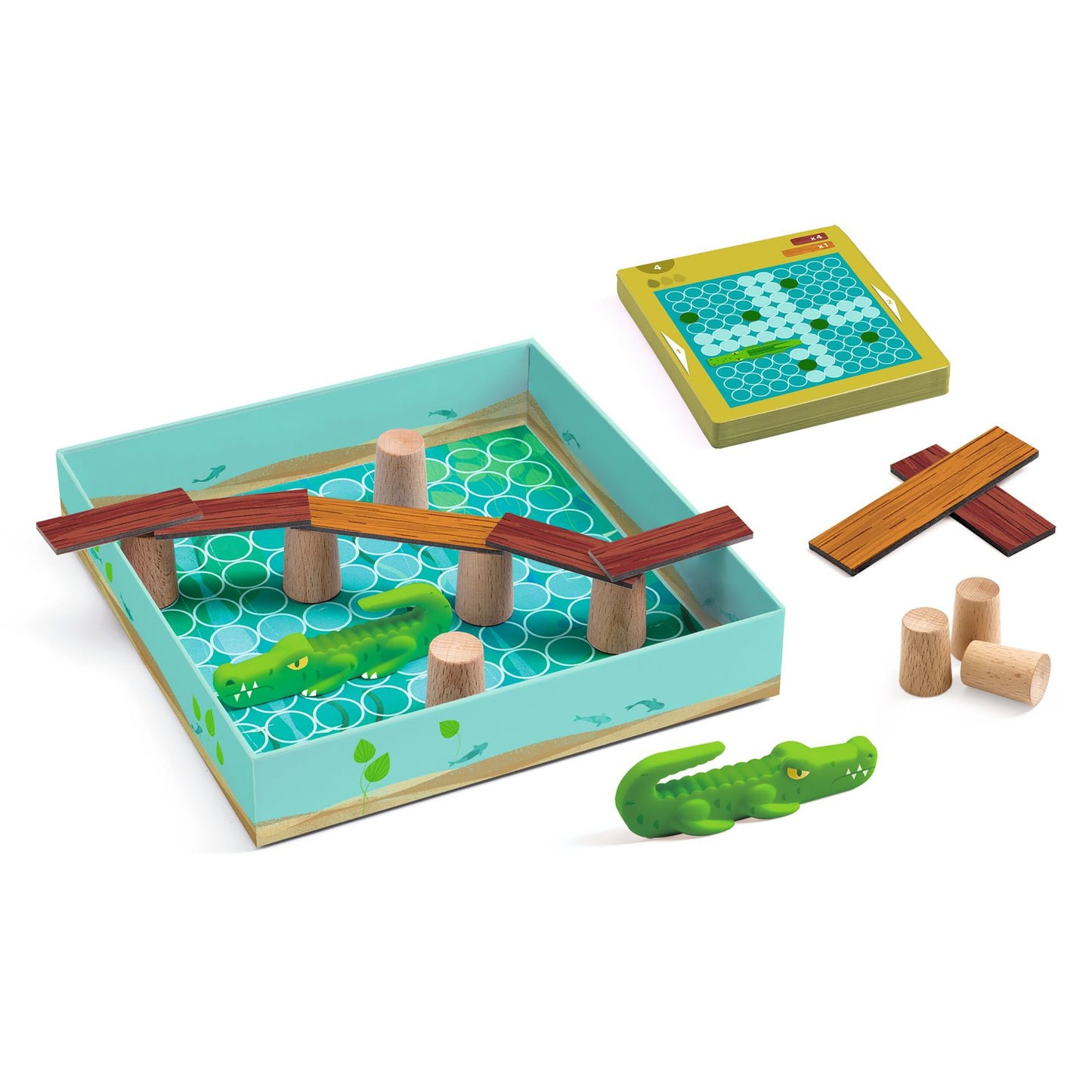
A gripping game in which strategy and reflection are required to reach the riverbank without going over the hungry crocodiles.
* As a verified institutional member, you benefit from special prices.
Log in to see the prices reserved for institutional members.
In stock
Couldn't load pickup availability


Observation
We ask children to exercise this skill every day in a multitude of activities. It is important to know that observation is never practiced alone: observing always requires concentration. This allows us to maintain attention while we gather information and commit it to our memory. How can we encourage the development of observation skills in children? First, it is important that the type of game and the difficulty level chosen are adapted to the child. The environment must be conducive to focus; it is essential to limit sources of distraction and to make the child comfortable. Guiding the child by asking questions can also help. To stimulate observation skills, we usually gravitate towards memory games, sorting games, sequence games or puzzles of all kinds, and that is great! But observation can also be practiced with all our senses. There are a variety of materials and activities that allow children to listen, touch, taste, look, smell, etc.

Fine Motor Skills
By manipulating pieces and fitting them together, children improve their dexterity, which prepares them to perform actions requiring more precise movements. A variety of activities help develop dexterity. Threading, drawing, cutting and manipulating various modelling clays gradually helps acquire the skills needed to master everyday gestures such as buttoning, lacing and zipping up and prepares children for writing. Preschoolers who do these types of activities will find it easier to trace letters.

Logical Reasoning
Logical thinking develops as children interact with their environment. Initially, they develop their reasoning through observations, comparisons and classifications of objects to then establish what distinguishes them or what unites them. Several activities require logical reasoning: solving a 3-D puzzle, doing a scientific experiment, building a model using instructions or playing chess. All of these activities require reflection and concentration and even call upon the ability to develop hypotheses and deductions in order to develop strategies. Exercising reasoning promotes the development of the ability to solve all problems.


