

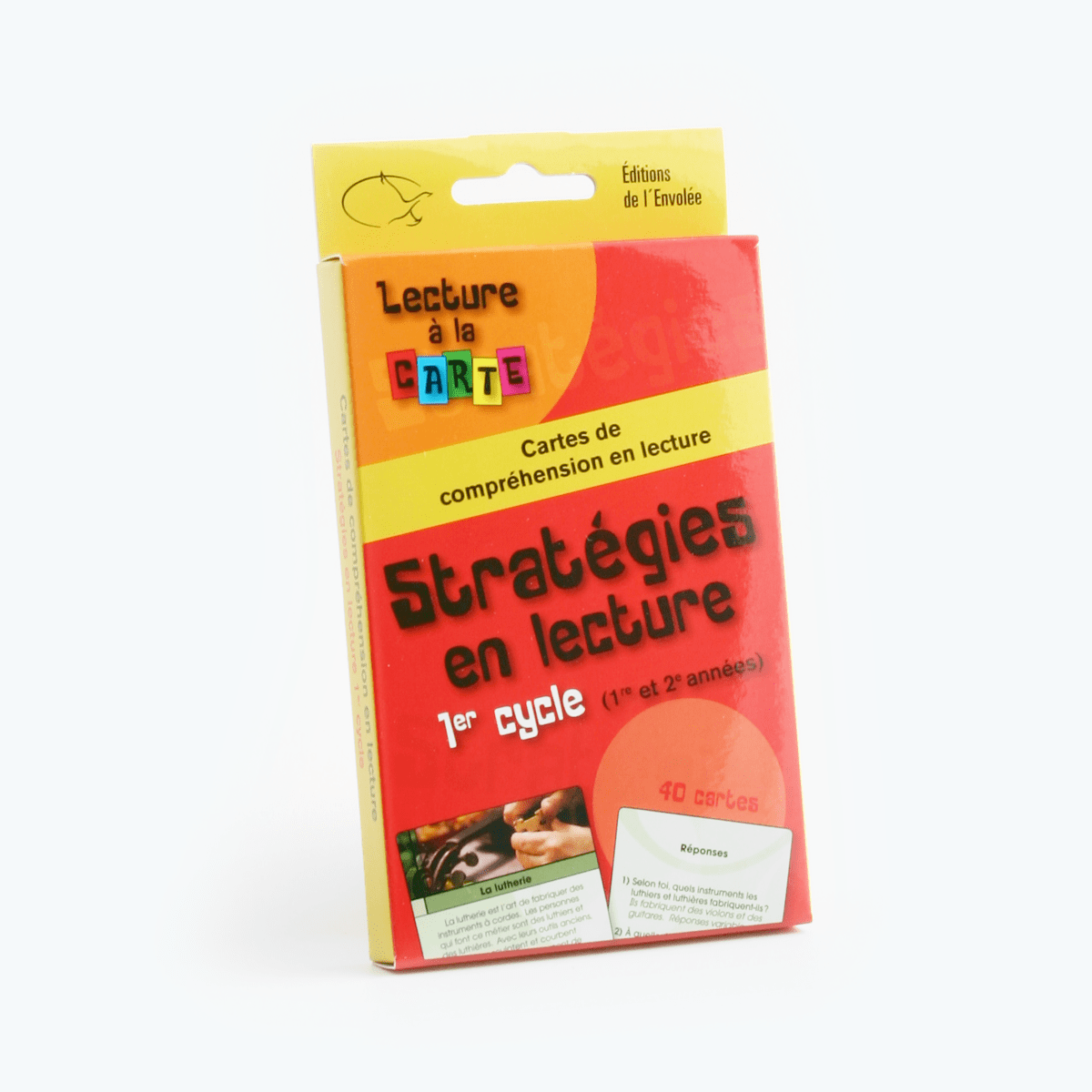
Lecture à la carte – 1er cycle
Lecture à la carte – 1er cycle
Regular price
102.95$
Regular price
0.00$
Sale price
102.95$
Unit price
per
Shipping calculated at checkout.
Available in French only.
* As a verified institutional member, you benefit from special prices.
Log in to see the prices reserved for institutional members.
Couldn't load pickup availability




Select your choices and quantities for a quick add to your order.
0
Total items
0.00$
Taxes and delivery charges extra.
Subtotal

Concentration
Concentration is the ability to focus attention on a single subject. Whether with work, reading or play, the process is always the same, and it is essential for learning. However, the ability to concentrate varies greatly depending on age and neurological development. Play is a natural ally of concentration. Anyone who has observed a child playing can attest to this. Many things can stimulate concentration. First, it is important to provide the child with a favourable learning environment: limit noise, have adequate physical and material organization, and fit the task duration as well as the challenge level to the child's abilities. Encouraging the child to follow a path with their finger, closing their eyes so that they listen to sounds, and reminding them of some of the characteristics of the task are strategies that help develop concentration. Finally, asking the child what they did to complete a task allows them to apply their strategies in other contexts.

Spoken Language
From the first babbling of a baby to the oral presentations of primary school children in front of the class, the concept of language undergoes a lot of development! From their first months, children need to communicate. To do this, they listen attentively to sounds and try to respond in their own way. Little by little, they understand that things and people are associated with sounds, and they try to reproduce them to make themselves understood. They make progress simultaneously in comprehension and expression, and they acquire vocabulary thanks to daily exchanges with their parents and educators. Children also exercise their ability to communicate and express their emotions during role-playing games and by adapting their speech to the situation they create. Spoken language can also be stimulated by all sorts of interventions: looking at books, learning nursery rhymes and songs, telling stories, discussing past events, making connections, and asking questions. Playing with words and finding rhymes and words that start with the same sound are all exercises in phonological awareness that help to perceive and identify the different components of words. Several studies prove that a child's language background impacts their success when learning to read and write.

Reading and Writing
Learning to identify written words and understanding their meaning is a major challenge for a 6-year-old child. Reading is a process that begins in first grade and is perfected throughout primary school. More than a visual decoding exercise involving knowledge of the alphabet and the ability to recognize words in general, reading requires that the child develop strategies to understand the meaning of the text. In addition, understanding texts is very important in learning all other school subjects. Producing a text calls upon several skills that must all be used simultaneously but which are gradually acquired during primary school through lessons in writing, spelling, grammar and punctuation.


