

Quebec Product
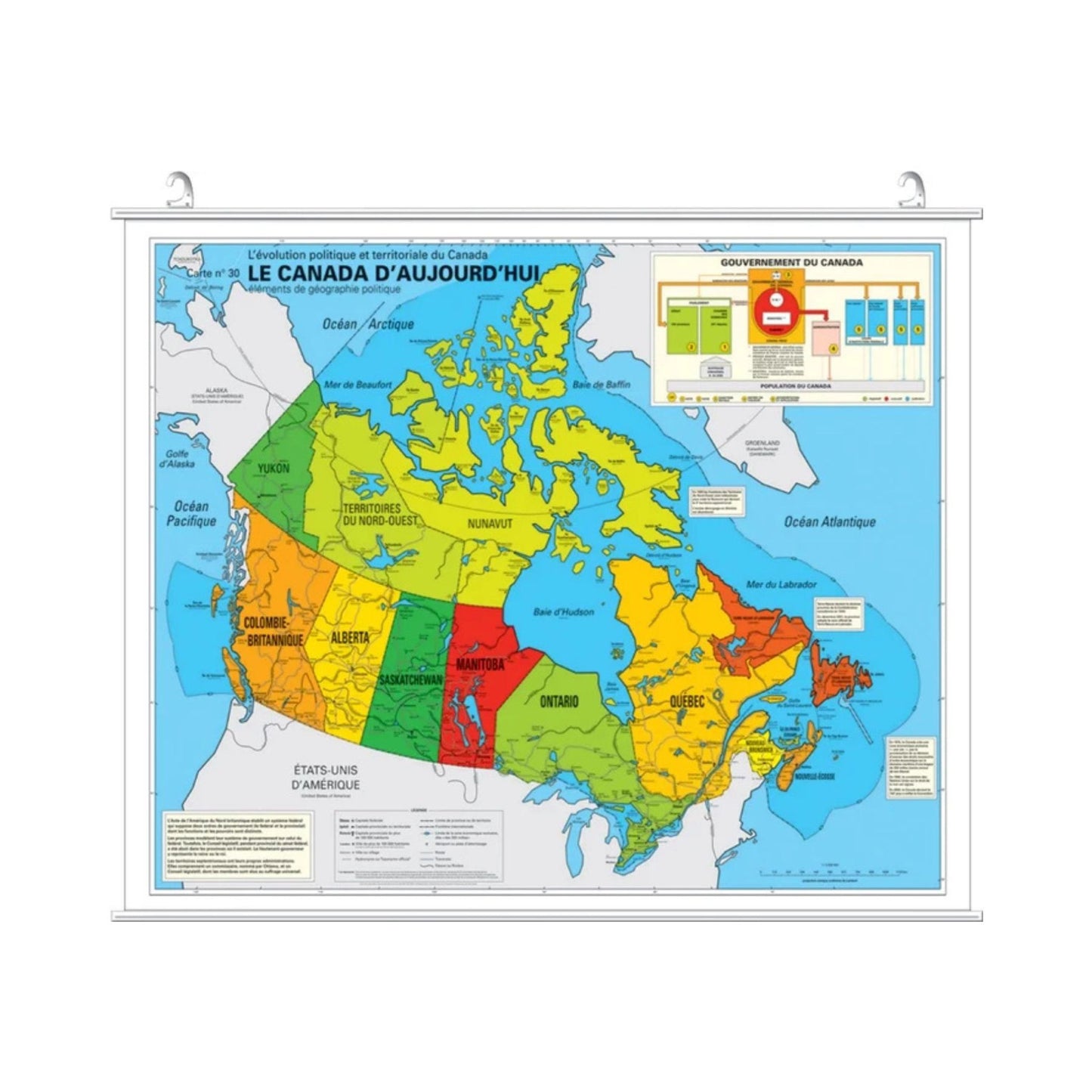
Le Canada d'aujourd'hui / carte politique
Le Canada d'aujourd'hui / carte politique
SKU: SKU : 4008397 Vendor : AMERIX
Regular price
309.00$
Regular price
0.00$
Sale price
309.00$
Unit price
per
Shipping calculated at checkout.
CARTE CANADA POLITIQUE CURS. 30A
* As a verified institutional member, you benefit from special prices.
Log in to see the prices reserved for institutional members.
Highly popular item - Currently being restocked to better serve you.
Délais supplémentaires à prévoir
Ce produit est susceptible de nécessiter un délai d’approvisionnement additionnel. Pour toute question, veuillez contacter votre représentant ou le service à la clientèle:
Couldn't load pickup availability

Space-Time
Space and time are at the heart of children's daily activities: drawing, writing, moving a piece on a game board, putting together a puzzle or building a building, as well as identifying landmarks to get from one point to another. All of these call for spatial organization and orientation. Furthermore, telling a story, correctly ordering a sequence of events, learning the time, and carrying out an activity in a set amount of time all call for temporal organization and orientation. All of these concepts are gradually developed through various motor and cognitive skills. This is easily observed in the development of children's language when they use the words inside, outside, next to, behind, before, after, yesterday and tomorrow. In short, skills related to spatial and temporal organization impact several areas of children's development.

General Knowledge
Children are naturally curious and eager to learn. Anyone who has tried to answer a child's many questions can attest to this. Play is, therefore, a great tool for developing general knowledge. All you need to do is vary the material and create opportunities for learning by using books, question-and-answer games, picture books or thematic activities with the appropriate support material. All these activities allow children to take control of the world around them, broaden their horizons, awaken their interests, develop their curiosity and activate several cognitive processes. This also promotes their social and emotional development. By observing the activities and games that children engage in, you can find ideas for activities and themes related to their interests and whose content and difficulty level will be adapted to them.

Spoken Language
From the first babbling of a baby to the oral presentations of primary school children in front of the class, the concept of language undergoes a lot of development! From their first months, children need to communicate. To do this, they listen attentively to sounds and try to respond in their own way. Little by little, they understand that things and people are associated with sounds, and they try to reproduce them to make themselves understood. They make progress simultaneously in comprehension and expression, and they acquire vocabulary thanks to daily exchanges with their parents and educators. Children also exercise their ability to communicate and express their emotions during role-playing games and by adapting their speech to the situation they create. Spoken language can also be stimulated by all sorts of interventions: looking at books, learning nursery rhymes and songs, telling stories, discussing past events, making connections, and asking questions. Playing with words and finding rhymes and words that start with the same sound are all exercises in phonological awareness that help to perceive and identify the different components of words. Several studies prove that a child's language background impacts their success when learning to read and write.


