


Build-A-Grid set
Build-A-Grid set
6 ans +
Regular price
27.95$
Regular price
0.00$
Sale price
27.95$
Unit price
per
Shipping calculated at checkout.
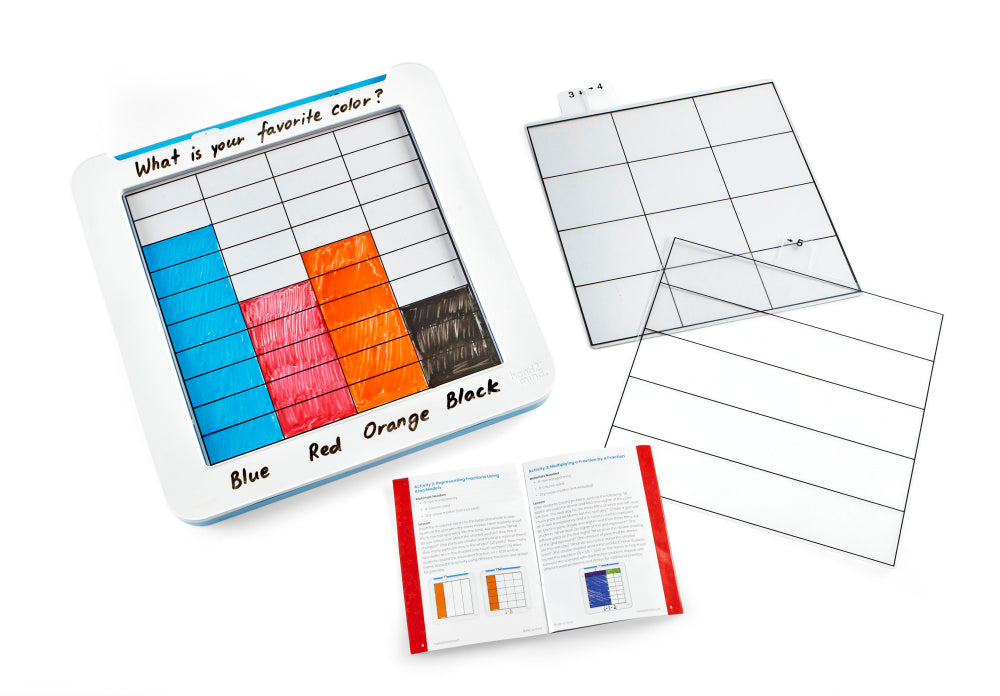
Bring abstract math concepts such as graphing, operations, fractions, decimals and areas to life. Simply lay transparencies over cards to build over 35 unique grids. Uses dry-erase markers (not included).
* As a verified institutional member, you benefit from special prices.
Log in to see the prices reserved for institutional members.
Couldn't load pickup availability

Select your choices and quantities for a quick add to your order.
0
Total items
0.00$
Taxes and delivery charges extra.
Subtotal

Space-Time
Space and time are at the heart of children's daily activities: drawing, writing, moving a piece on a game board, putting together a puzzle or building a building, as well as identifying landmarks to get from one point to another. All of these call for spatial organization and orientation. Furthermore, telling a story, correctly ordering a sequence of events, learning the time, and carrying out an activity in a set amount of time all call for temporal organization and orientation. All of these concepts are gradually developed through various motor and cognitive skills. This is easily observed in the development of children's language when they use the words inside, outside, next to, behind, before, after, yesterday and tomorrow. In short, skills related to spatial and temporal organization impact several areas of children's development.

Reading and Writing
Learning to identify written words and understanding their meaning is a major challenge for a 6-year-old child. Reading is a process that begins in first grade and is perfected throughout primary school. More than a visual decoding exercise involving knowledge of the alphabet and the ability to recognize words in general, reading requires that the child develop strategies to understand the meaning of the text. In addition, understanding texts is very important in learning all other school subjects. Producing a text calls upon several skills that must all be used simultaneously but which are gradually acquired during primary school through lessons in writing, spelling, grammar and punctuation.

Logical Reasoning
Logical thinking develops as children interact with their environment. Initially, they develop their reasoning through observations, comparisons and classifications of objects to then establish what distinguishes them or what unites them. Several activities require logical reasoning: solving a 3-D puzzle, doing a scientific experiment, building a model using instructions or playing chess. All of these activities require reflection and concentration and even call upon the ability to develop hypotheses and deductions in order to develop strategies. Exercising reasoning promotes the development of the ability to solve all problems.


